
Every US business paying contractors will file differently this January. Very few have yet adjusted how they track vendor spend.
Reporting rules rarely move, so most finance workflows get built once and left alone for years. This one shifts the line that decides which vendors generate paperwork at all. The 1099 threshold 2026 already applies to payments going out now, so the work belongs in December, not January.
The change applies to payments made after 31 December 2025.
"Every founder asks whether the new threshold saves them work. It does. What they should be asking is whether their vendor records are clean enough to prove which side of $2,000 each contractor landed on."
JOHN ORTELLE
Key Takeaways
Here is what changed, what stayed the same, and what US businesses need ready before January filing. The threshold moved, but the deadlines did not, and the rules on taxable income are exactly where they were. Read this before assuming anything.
- The 1099 threshold 2026 rises from $600 to $2,000 for payments made after 31 December 2025
- First adjustment to this limit since 1954, indexed for inflation from 2027
- Form 1099-K reverted separately to $20,000 and 200+ transactions
- All income remains taxable even when no form is issued
The 1099 threshold 2026 is $2,000. Under the One Big Beautiful Bill Act, US businesses now issue Form 1099-NEC and Form 1099-MISC only when payments to a contractor or vendor reach $2,000 within a calendar year, replacing the $600 limit that had stood since 1954. The change applies to payments made after 31 December 2025.
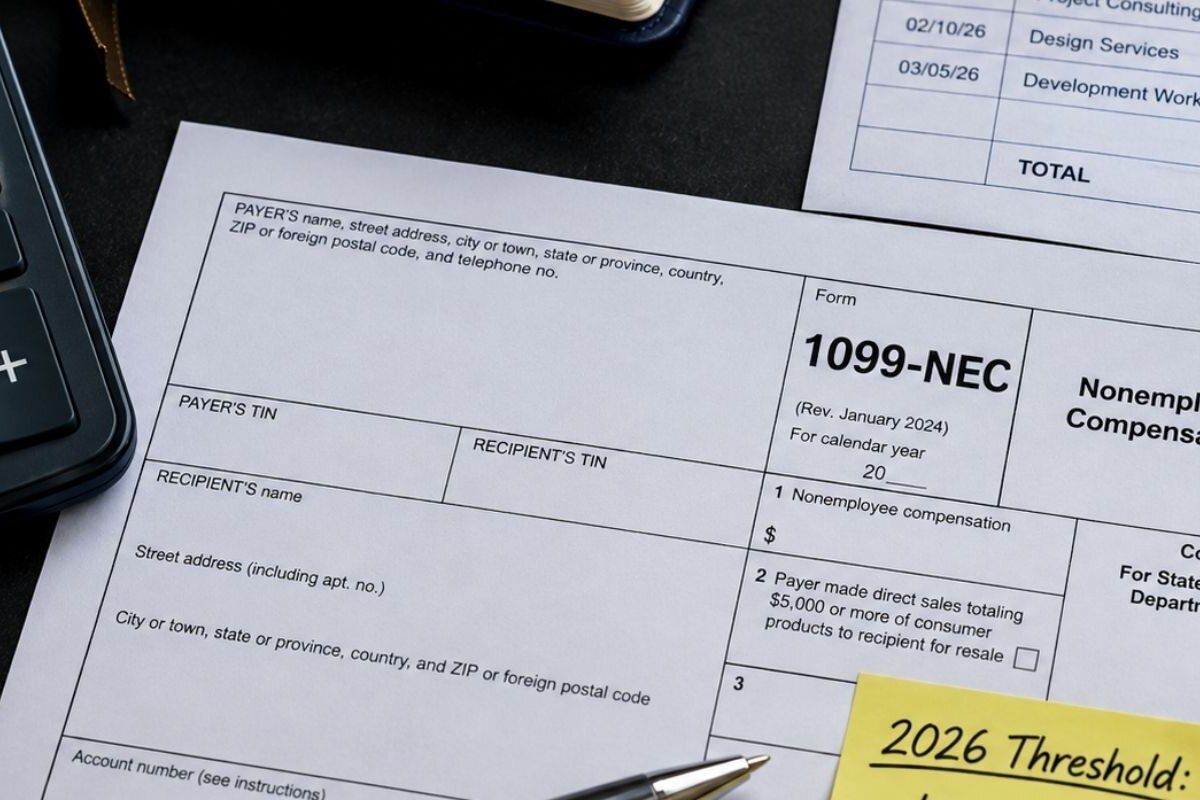
What Changed With the 1099 Threshold 2026
For seventy-one years the rule was simple: pay a contractor $600 or more in a year, issue a 1099. That figure never moved, even as $600 in 1954 lost most of its real value. The 1099 threshold 2026 changes that. The reporting floor is now $2,000, indexed for inflation from 2027 so it never falls this far behind again.
For a business paying twenty contractors a year this is not a minor note. The occasional consultant, the one-off designer, the part-time bookkeeper — several may now fall below the line entirely. The practical effect is fewer forms and fewer W-9s to chase. But only if your vendor records can tell you who crossed $2,000 and who did not.
Understanding the 1099-NEC Threshold 2026
Form 1099-NEC reports non-employee compensation — payments to freelancers, contractors and professional service providers. The 1099-NEC threshold 2026 sits at $2,000, matching the general 1099 threshold 2026. Form 1099-MISC, covering rent, prizes, awards and certain legal payments, moves to the same figure.
One point worth being precise about: the threshold is cumulative across the calendar year, not per payment. Four payments of $600 to the same contractor total $2,400 and still trigger a filing obligation. This is where businesses without clean vendor ledgers get caught out, and a common reason bookkeeping cleanup engagements begin in January rather than December.
Full 1099 Reporting Requirements 2026
The complete 1099 reporting requirements 2026 include several elements that did not change, plus one significant reversal.
Filing deadlines are unchanged. Form 1099-NEC is due to the recipient and the IRS by 31 January. Form 1099-MISC is due to recipients by 31 January and to the IRS by 28 February on paper or 31 March electronically.
Electronic filing mandates expanded again for 2026, and paper filing thresholds continue to tighten.
W-9 collection remains essential. The 1099 reporting requirements 2026 still assume you hold a completed W-9 for every vendor before the first payment goes out. Collecting it afterward is harder, and a missing taxpayer identification number can trigger backup withholding.
State obligations do not automatically follow federal ones. Some states join the Combined Federal/State Filing Program; others require direct submission on different deadlines. If you operate across state lines, verify each jurisdiction separately – the same principle behind multi-state payroll compliance.
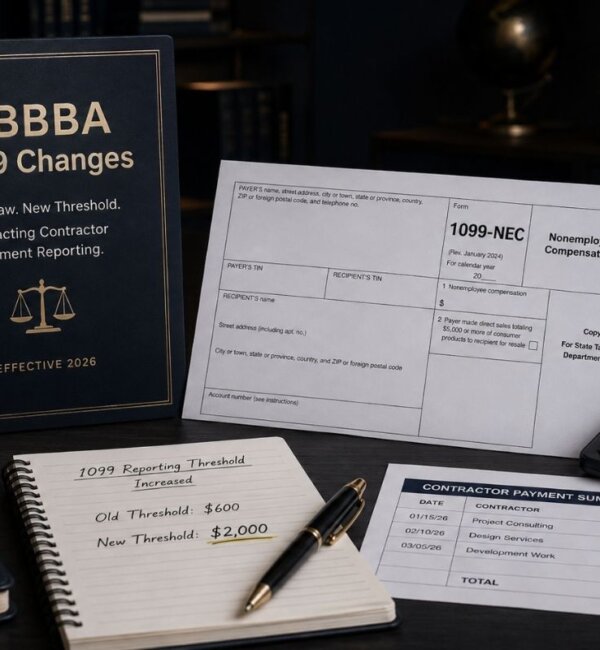
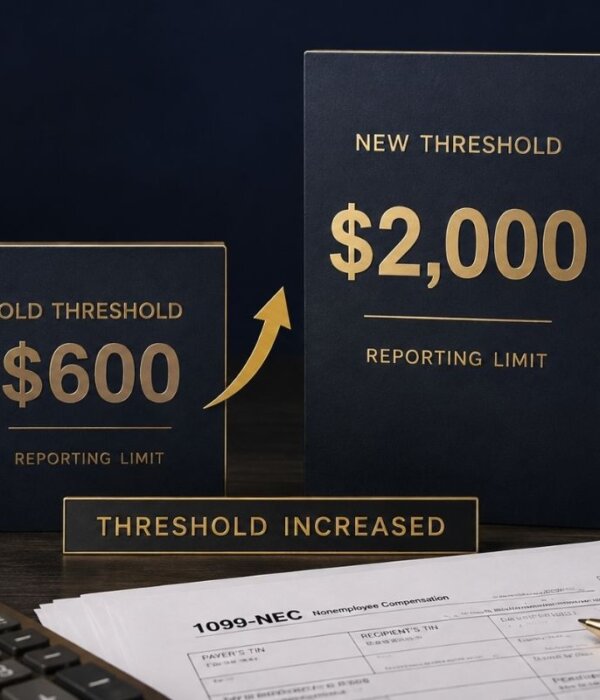
Why the 1099 Threshold Change 2000 Dollars Matters
The 1099 threshold change 2000 dollars is not simply about issuing fewer forms. It changes how vendor spending should be tracked through the year.
Under the old rule almost any recurring vendor crossed $600 quickly, so the safe approach was to treat everyone as reportable. The 1099 threshold 2026 introduces a genuine sorting exercise, visible only if your books separate contractor payments by payee.
The 1099 threshold change 2000 dollars also interacts with backup withholding, which now aligns at the same level. If a vendor has not supplied a valid taxpayer identification number and payments cross $2,000, withholding begins.
For businesses running accurate monthly financial reporting, this is straightforward. For those reconciling once a year, it is a January problem waiting to happen.
OBBBA 1099 Reporting Changes at a Glance
The OBBBA 1099 reporting changes arrived as part of a broader tax package. Here is the complete picture in one view.
| Item | Previous rule | 2026 rule | Effective |
|---|---|---|---|
| 1099-NEC threshold | $600 | $2,000 | Payments after 31 Dec 2025 |
| 1099-MISC threshold | $600 | $2,000 | Payments after 31 Dec 2025 |
| Backup withholding threshold | $600 | $2,000 | Payments after 31 Dec 2025 |
| Inflation indexing | None | Annual | From 2027 |
| 1099-K threshold | $600 (phasing in) | $20,000 AND 200+ transactions | Reverted, retroactive to 2022 |
| 1099-NEC filing deadline | 31 January | 31 January | Unchanged |
The 1099-K reversal deserves separate attention. Payment platforms had been preparing for a $600 reporting floor. That phase-in was reversed and the threshold returned to $20,000 combined with more than 200 transactions, applied retroactively to 2022.
The OBBBA 1099 reporting changes therefore move in two directions: fewer contractor forms, and considerably fewer platform forms.
Old Rules vs New Rules
Before 2026 | From 2026 | |
|---|---|---|
Vendors requiring a form | Nearly all recurring vendors | Only those above $2,000 |
Admin burden in January | High | Meaningfully reduced |
Tracking precision needed | Low — most crossed the line anyway | High — the line now genuinely sorts |
Risk if books are messy | Over-filing, which is harmless | Under-filing, which carries penalties |
The verdict: the new rule reduces paperwork but raises the cost of poor record-keeping. Under $600, filing an unnecessary form caused no harm. Under $2,000, missing a required one does.
EXPERT INSIGHT
Animesh Shah, Accounting Lead at Finkeepers
“The businesses that will handle the 1099 threshold 2026 smoothly are the ones already tracking vendor payments by payee through the year. The ones that will struggle are those reconciling contractor spend in January. We see it every filing season – the threshold itself is never the problem, the vendor ledger is. If you cannot pull a report showing total paid per vendor in under two minutes, that is the thing to fix before January, not the 1099 process itself.”
The verdict: the new rule reduces paperwork but raises the cost of poor record-keeping. Under $600, filing an unnecessary form caused no harm. Under $2,000, missing a required one does.
EXPERT INSIGHT
A spreadsheet that tracks cumulative payments per vendor against the $2,000 threshold, flags who needs a form, and shows which W-9s are outstanding.

FREQUENTLY ASKED QUESTIONS
Everything US Businesses Ask,About the 1099 Threshold 2026"
What is the 1099 threshold for 2026?
The 1099 threshold 2026 is $2,000. Businesses issue Form 1099-NEC or 1099-MISC only when total payments to a contractor or vendor reach $2,000 within the calendar year. This replaces the $600 threshold that applied from 1954 through the end of 2025, and applies to payments made after 31 December 2025.
Did the 1099 reporting threshold change from $600 to $2,000?
Yes. The One Big Beautiful Bill Act raised the threshold from $600 to $2,000 for payments made after 31 December 2025 — the first change in more than seventy years. It will be indexed for inflation annually from 2027.
Do I still need to report income under $2,000 if no 1099 is issued?
Yes. This is the most important point in the change. All income remains fully taxable regardless of whether a 1099 is issued. The threshold governs when a business must issue a form, not whether the recipient owes tax. A contractor paid $1,800 still reports that income.
What is the 1099-K threshold for 2026?
The 1099-K threshold returned to $20,000 in gross payments combined with more than 200 transactions. The previously planned reduction to $600 was reversed, and the reversal applies retroactively to 2022. Payment platforms and online marketplaces issue Form 1099-K only when both conditions are met.
What is the 1099 threshold for 2026?
The 1099 threshold 2026 is $2,000. Businesses issue Form 1099-NEC or 1099-MISC only when total payments to a contractor or vendor reach $2,000 within the calendar year. This replaces the $600 threshold that applied from 1954 through the end of 2025, and applies to payments made after 31 December 2025.
Does the new 1099 threshold apply to payments made in 2025?
No. The 1099 threshold 2026 applies to payments made after 31 December 2025. Payments made during 2025 remain subject to the old $600 threshold and are reported on forms filed in early 2026 under the previous rules.
What happens if I miss a required 1099 filing?
Penalties apply per form and increase the longer a filing is late, with higher amounts for intentional disregard. Because the 1099 threshold 2026 raises the reporting floor, the risk shifts from over-filing to under-filing — missing a vendor who crossed $2,000 is now the likelier error, and the costly one.
Getting the 1099 threshold 2026 right comes down to one thing: knowing what you paid each vendor before January arrives. If contractor payments are spread across cards, bank transfers and platforms, that visibility is worth building now. Finkeepers handles contractor and 1099 management for US businesses as part of ongoing payroll support – talk to a Finkeepers accountant if January filing is already looking complicated.
See what US businesses say about working with Finkeepers on Clutch.

Written by the Finkeepers Team
Getting the 1099 threshold 2026 right comes down to one thing: knowing what you paid each vendor before January arrives. If contractor payments are spread across cards, bank transfers and platforms, that visibility is worth building now. Finkeepers handles contractor and 1099 management for US businesses as part of ongoing payroll support — talk to a Finkeepers accountant if January filing is already looking complicated.
Disclaimer: This article is provided for general informational purposes only and does not constitute tax, legal or accounting advice. Reporting thresholds and filing requirements change, and rules vary by state. Verify all figures against IRS.gov and consult a qualified professional before acting. Finkeepers accepts no liability for decisions made on the basis of this content. Current as of August 2026.

Get Your Free Accounting Consultation Today
*No obligations. Just fast, expert fractional CFO insights tailored for your US business needs.

Built by experienced professionals, Finkeepers delivers reliable accounting services for startups and SMBs, powered by proven processes and modern software.
Contact Info:
-
Address: 30 N Gould ST STE R, Sheridan, Wyoming, 82801 United States
-
Email: hi@finkeepers.us
-
Phone: +1-408-370-2711