

Most small businesses inherit a chart of accounts from software defaults. Very few ever check whether it actually fits.
A chart of accounts for small business gets built once, usually in the first week of trading, then quietly shapes every report the business produces for years afterwards. Get the structure right early and reporting stays clean as you grow. Get it wrong and every month-end carries the cost.
A chart of accounts for small business sorts every transaction into five account types: assets, liabilities, equity, revenue and expenses. Standard numbering runs 1000s through 5000s. Over-segmentation causes more reporting pain than under-segmentation, and restructuring mid-year breaks period comparison unless historical entries are remapped.
Structure matters far more than the number of accounts.
"Nine times out of ten the problem is not that a business has too few accounts. It is that someone added a new one every time they were unsure where something belonged, and now the profit and loss runs to four pages nobody reads."
ANIMESH SHAH
Key Takeaways
Here is what a chart of accounts does, how to structure one that scales with the business, and the mistakes that force a painful rebuild later. Most of the work happens in the first hour of setup, and most of the pain comes from skipping it.
- A chart of accounts for small business sorts every transaction into five account types
- Standard numbering runs 1000s assets, 2000s liabilities, 3000s equity, 4000s revenue, 5000s expenses
- Over-segmentation causes more reporting pain than under-segmentation
- Restructuring mid-year breaks period comparison unless historical entries are remapped
A chart of accounts for small business is the master list of every account used to record transactions, organised into assets, liabilities, equity, revenue and expenses. It determines what every financial report the business produces is able to show.

What a Chart of Accounts for Small Business Actually Does
Every transaction a business records has to land somewhere. The chart of accounts for small business is simply the list of places it can land.
That sounds administrative, and it is. But the consequence is not. A profit and loss statement can only show what the account structure allows it to show. If marketing spend, software subscriptions and contractor fees all sit in one account called Operating Expenses, no report will ever tell you which of the three is growing.
This is why the structure gets decided before the reporting question is asked, and why it is worth an hour of thought rather than accepting whatever the software installed by default.
How to Set Up a Chart of Accounts
Knowing how to set up a chart of accounts starts with the five account types, because everything else follows from them.
Assets are what the business owns. Liabilities are what it owes. Equity is the difference. Revenue is what comes in. Expenses are what goes out. Every account belongs to exactly one of these, and the order matters because it mirrors the balance sheet and the profit and loss.
A chart of accounts for small business is built in that order for a reason. Assets and liabilities come first, since those are largely dictated by the bank accounts, cards and loans the business already holds. Revenue comes next, and should mirror how the business actually earns rather than how the industry describes itself. Expenses come last and take the longest, because that is where judgement is required.
If the business already runs on QuickBooks or Xero, work from the default list rather than starting blank. Delete what is irrelevant, rename what is close, and only add where a genuine gap exists. Our bookkeeping team does exactly this during onboarding.
Chart of Accounts Best Practices
The chart of accounts best practices that matter are mostly about restraint.
Create an account when you need to see a number separately on a report. Not when a transaction feels different. That single rule prevents most of the sprawl we see in inherited books.
Keep names plain and consistent across the chart of accounts for small business. Software Subscriptions is better than SaaS Tools and Software Costs sitting as two separate accounts because two people made the same decision differently six months apart.
Use sub-accounts for detail rather than creating new top-level accounts. A parent account called Marketing with children for Paid Advertising, Content and Events reports cleanly at both levels. Five unrelated top-level marketing accounts do not.
Review annually, not monthly. Chart of accounts best practices include leaving the structure alone long enough for period comparison to mean something.


The Chart of Accounts Numbering System
A chart of accounts numbering system exists so accounts sort themselves into the right order on every report, without anyone having to think about it.
The convention is near-universal across US accounting software, which is what makes it worth applying to any chart of accounts for small business even if your software does not require numbers.
Leave gaps. Numbering accounts 1000, 1010, 1020 rather than 1000, 1001, 1002 means a new account can be inserted in the right place later rather than appended to the bottom. A chart of accounts numbering system with no gaps becomes disordered within a year.
Building a Chart of Accounts Template for Startups
A chart of accounts template for startups looks different from a chart of accounts for small business built at a later stage, mostly because the reporting audience is different. Investors and boards want to see gross margin, burn and headcount cost clearly separated. That has to be designed in.
The structure below works as a starting point for most US startups and small businesses. Adapt the expense section to the business model, and leave the rest largely as is.
| Range | Account type | Example accounts | Appears on |
|---|---|---|---|
| 1000-1999 | Assets | Operating bank, Accounts receivable, Prepaid expenses | Balance sheet |
| 2000-2999 | Liabilities | Accounts payable, Credit card, Payroll liabilities | Balance sheet |
| 3000-3999 | Equity | Common stock, Retained earnings, Owner contributions | Balance sheet |
| 4000-4999 | Revenue | Subscription revenue, Services revenue, Other income | Profit and loss |
| 5000-5999 | Cost of revenue | Hosting, Payment processing, Direct labour | Profit and loss |
| 6000-6999 | Operating expenses | Salaries, Rent, Software, Marketing, Professional fees | Profit and loss |
Splitting cost of revenue from operating expenses is the single most useful decision in this structure. Without it, gross margin cannot be calculated, and gross margin is the first number most investors look for.
Too Few Accounts vs Too Many
Too few accounts | Too many accounts | |
|---|---|---|
Monthly bookkeeping | Fast, few decisions | Slow, constant judgement calls |
Reporting detail | Too coarse to act on | Detailed but unreadable |
Consistency across periods | High | Low — same expense coded differently |
Fix required later | Add accounts, straightforward | Merge accounts, breaks history |
The verdict: start narrower than feels right. Adding an account later is a five-minute job. Merging thirty accounts back into eight means remapping every historical transaction, and most businesses never get round to it.
EXPERT INSIGHT
Pankaj Gohel, Finance Operations Lead at Finkeepers
“When we take over books, the first thing we look at is not the numbers, it is the account list. If it runs past about sixty accounts for a business under $5 million in revenue, we already know the monthly reporting is inconsistent. Somebody has been creating accounts instead of asking where things belong.”
A tight chart of accounts for small business is not about having fewer options. It is about having a structure where the right answer is obvious to whoever is doing the coding that month.
PUT THIS INTO PRACTICE
Setting up a chart of accounts for small business is straightforward. Restructuring one that has already been running for three years is not. If your account list has grown past the point where reports are useful, a review is worth doing before the next financial year rather than after it.

FREQUENTLY ASKED QUESTIONS
Everything US Businesses Ask,About the Chart of Accounts
How do I set up a chart of accounts for a small business?
Start with the five account types: assets, liabilities, equity, revenue and expenses. Build assets and liabilities first from the bank accounts and cards you already hold, then revenue to match how the business earns, then expenses last. Work from your software’s default list rather than starting from blank.
What are the 5 main account types in a chart of accounts?
Assets, liabilities, equity, revenue and expenses. Assets are what the business owns, liabilities are what it owes, equity is the difference between the two. Revenue is money earned and expenses are money spent. Every account belongs to exactly one of these five categories.
What numbering system should a chart of accounts use?
The standard US convention runs 1000-1999 for assets, 2000-2999 liabilities, 3000-3999 equity, 4000-4999 revenue and 5000 upward for expenses. Leave gaps between numbers so new accounts can be inserted in the correct position later rather than appended at the end.
How many accounts should a small business have?
A chart of accounts for small business under $5 million in revenue operates comfortably on 30 to 60 accounts. Beyond that, monthly coding becomes inconsistent because the right answer stops being obvious. Use sub-accounts for detail rather than adding more top-level accounts.
Can I change my chart of accounts mid-year?
You can, but period comparison breaks unless historical transactions are remapped to the new structure. If a change is needed, the cleanest time is at the start of a financial year. Mid-year restructuring should be planned deliberately rather than done piecemeal.
What is the difference between cost of revenue and operating expenses?
Cost of revenue is what it costs to deliver the product or service, such as hosting, payment processing or direct labour. Operating expenses are the costs of running the business regardless of volume, such as rent and salaries. Separating them is what makes gross margin calculable.
A chart of accounts for small business is one of the few pieces of financial infrastructure that is cheap to get right at the start and expensive to fix later. If the structure was inherited from a software default and nobody has looked at it since, that is worth an hour before the next year begins. Finkeepers handles this as part of outsourced bookkeeping onboarding, and it feeds directly into cleaner financial reporting every month. Talk to a Finkeepers accountant if your account list has stopped being useful.
See what US businesses say about working with Finkeepers on Clutch.
Written by the Finkeepers Team
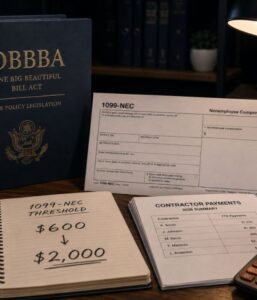
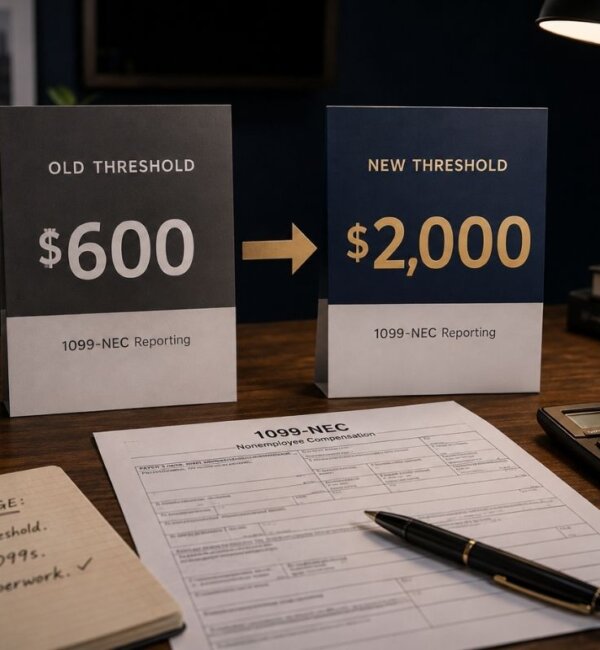
Getting the 1099 threshold 2026 right comes down to one thing: knowing what you paid each vendor before January arrives. If contractor payments are spread across cards, bank transfers and platforms, that visibility is worth building now. Finkeepers handles contractor and 1099 management for US businesses as part of ongoing payroll support — talk to a Finkeepers accountant if January filing is already looking complicated.
Disclaimer: This article is provided for general informational purposes only and does not constitute tax, legal or accounting advice. Account structures and reporting requirements vary by business type and jurisdiction. Consult a qualified professional before restructuring your books. Finkeepers accepts no liability for decisions made on the basis of this content. Current as of August 2026.
Get Your Free Bookkeeping Consultation Today
*No obligations. Just fast, expert bookkeeping insights tailored for your US business needs.

Built by experienced professionals, Finkeepers delivers reliable accounting services for startups and SMBs, powered by proven processes and modern software.
Contact Info:
-
Address: 30 N Gould ST STE R, Sheridan, Wyoming, 82801 United States
-
Email: hi@finkeepers.us
-
Phone: +1-408-370-2711