
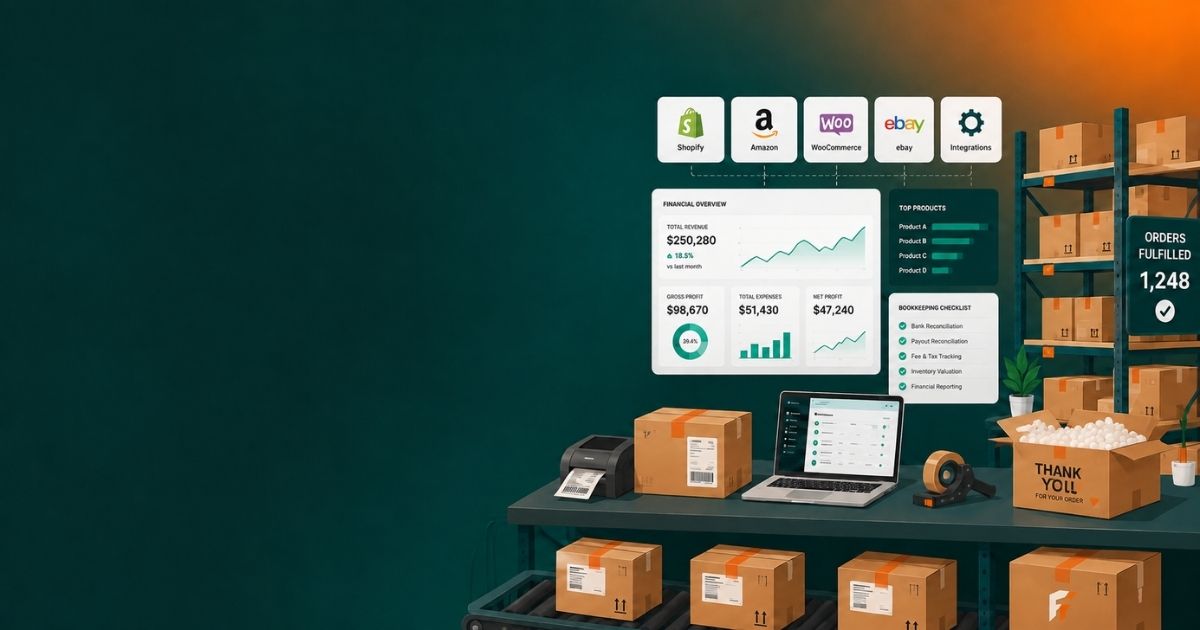





Behind every seller who knows their real margin is a set of books where payouts reconcile to gross sales. Finkeepers delivers ecommerce bookkeeping services covering multi-channel reconciliation, inventory and cost of goods, sales tax nexus, and monthly close built for how online retail actually settles.
We support Shopify merchants, Amazon sellers, multi-channel brands, and subscription commerce operators across the United States. Your dedicated pod handles the reconciliation so you can focus on acquisition and product.
Ecommerce accounting services from Finkeepers replace the cost of an in-house finance hire. You get people who already understand marketplace fee structures and deferred revenue on subscriptions, rather than a generalist learning platform payouts on your data.
Why it matters: ecommerce is the category where reported revenue and actual revenue diverge most often. Platforms deposit net of fees, refunds, chargebacks, and promotions, so a bank deposit recorded as revenue understates both sales and cost, and margin looks better than it is.
How it works: every payout is reconciled gross to net, so fees, refunds, and adjustments land in the right accounts. Inventory is valued consistently and landed cost is captured, which is what makes cost of goods reflect what the product genuinely cost to sell.
The bottom line: know your true margin per product, not per deposit. Explore our bookkeeping services, review cash flow management, or book a free consultation.
Selling online is complicated enough. Your books should not add to it. Finkeepers delivers shopify bookkeeping services, amazon seller accounting, and inventory reporting that help US online sellers see true product profitability rather than platform deposits.
Ecommerce accounting is distinctive because the money that arrives is never the money that was earned. Fees, refunds, and promotions are netted before deposit. Below are the four situations where that gap costs sellers the most.
From payout reconciliation to inventory valuation, every deliverable US online sellers need, handled by a dedicated Finkeepers pod. Whether you sell on one channel or five, the scope adjusts to how your store operates.
Shopify, Amazon, Walmart, Etsy, and wholesale reconciled individually, with platform fees, refunds, chargebacks, and promotional discounts posted to the right accounts. Gross sales recorded as gross rather than as the deposit that landed.
Consistent inventory valuation, landed cost including freight and duty, and cost of goods matched to the period the sale occurred. Shrinkage and damaged stock accounted for rather than absorbed silently into margin.
Economic nexus monitored by state against revenue and transaction thresholds, with registration flagged before the obligation is triggered rather than after. Marketplace facilitator rules applied where the platform collects on your behalf.
Books closed by the 10th business day with contribution margin by channel, cost of goods breakdown, and comparison against prior periods. Reporting that answers which products and channels actually earn.
Whether you run on Shopify, Amazon Seller Central, WooCommerce, BigCommerce, or QuickBooks, Finkeepers works fluently across every leading US ecommerce platform. Certified experts, seamless integration, and no disruption to how your store already runs.















Most providers keep pricing behind a discovery call. We would rather you knew before you called. Ecommerce pricing tracks channel count and inventory complexity rather than revenue, because reconciliation volume is what drives the work.
Seller profile | Channels | Typical monthly range |
Single channel, no inventory | 1 | $400 – $700 |
Single channel with inventory | 1 | $700 – $1,300 |
Multi-channel brand | 2 – 4 | $1,300 – $2,400 |
High volume or multi-entity | 5+ | Scoped individually |
Sales tax registration in new states is quoted separately, because agency fees and filing frequency vary by jurisdiction. There are no setup fees, no long-term contracts, and no charge for the initial assessment.
| In-house bookkeeper | Finkeepers |
Annual cost | $45,000 to $65,000 plus benefits and payroll tax | Fixed monthly fee, no employment overhead |
Payout reconciliation | Often recorded net, because gross is more work | Gross to net on every channel |
Nexus monitoring | Usually discovered after the threshold is crossed | Tracked by state against live thresholds |
Coverage when absent | Reconciliation stops during leave or illness | A pod, so continuity is built in |
Review layer | Usually none – one person checks their own work | Preparer, reviewer, and manager sign-off |
Adding a channel | Requires learning a new settlement format | Handled within the existing scope |
An in-house bookkeeper makes sense once volume supports a full-time role with a reviewer above them. Below that point, the multi-channel reconciliation discipline usually matters more than having someone in the building.
Built on ISO 27001:2022 certified security, US-trained accountants, and a leadership team of industry veterans, Finkeepers carries the trust markers online sellers look for before granting access to platform and payment data.

Independently audited information security meeting the highest international standards for handling financial and payment data. Not a badge we designed ourselves.
Accountants who work in marketplace settlement, landed cost, and economic nexus as routine practice rather than occasional exceptions.
A leadership team with decades of combined experience across accounting, audit, and financial operations for US companies.
US sellers and SMBs stay with Finkeepers long-term because of consistent, reliable, expert financial partnership.

Every store runs a different channel mix, fulfilment model, and inventory structure, and so does our approach. Share your details and get a personalized plan built around your store and stage of growth.
*No obligations. Just fast, expert ecommerce accounting insights tailored for your US store.

Ecommerce bookkeeping services means partnering with a firm like Finkeepers to reconcile platform payouts gross to net, value inventory, track cost of goods, monitor sales tax nexus, and close the books monthly. The defining difference from standard bookkeeping is that revenue is recorded at gross sales rather than at the deposit the platform sends.
Shopify deposits net of processing fees, refunds, chargebacks, and any adjustments. Correct reconciliation records gross sales as revenue, then posts fees, refunds, and chargebacks to their own accounts so the deposit ties out. Recording the deposit as revenue understates both sales and expenses, which makes gross margin look better than it is.
Amazon settles on a rolling basis with a longer list of deductions, including referral fees, FBA fulfilment fees, storage, long-term storage, advertising, and reimbursements. Each needs its own account to see true contribution margin per product. Inventory sitting in Amazon warehouses also remains your asset and must be valued accordingly.
Economic nexus is triggered when you exceed a state’s revenue or transaction threshold, and those thresholds differ by state. Marketplace facilitator rules mean platforms collect and remit on your behalf in many states, but that does not always remove your registration obligation. Monitoring thresholds before you cross them is considerably cheaper than backdating.
Most US online sellers use either FIFO or weighted average, applied consistently period to period. What matters more than the method is capturing landed cost, meaning product cost plus freight, duty, and inbound handling, because omitting those understates cost of goods and overstates margin on every unit.
Ecommerce bookkeeping services typically cost between $400 and $2,400 per month for US sellers, driven by channel count and inventory complexity rather than revenue. Sales tax registrations are quoted separately. Finkeepers offers transparent pricing with no setup fees and no long-term contract.
Built by experienced professionals, Finkeepers delivers reliable accounting services for startups and SMBs, powered by proven processes and modern software.