

Finance teams do not close slowly because they lack people. They close slowly because nobody sequenced the work.
Every business closes its books. Very few have written down the order in which it happens, which is why the same bottleneck reappears month after month. A month end close checklist turns a scramble into a sequence, and a sequence is the only thing that makes the timeline predictable.
A month end close checklist runs in three strict phases: reconcile, adjust, then review. Ten business days is the working benchmark for US small businesses. Bank feed lag and unreconciled receivables are the two most common delays, and close speed is a process problem rather than a headcount problem.
Ten business days is achievable for most US small businesses.
"The close is never late because of the accounting. It is late because someone is still waiting on a bank feed, a receipt, or an answer from another department. Fix the inputs and the close fixes itself."
PANKAJ GOHEL
Key Takeaways
Here is the sequence, the realistic timeline, and the bottlenecks that push most closes past two weeks. The order matters more than the effort, because each stage depends on the one before it.
- A month end close checklist runs in three phases: reconcile, adjust, then review
- Ten business days is the working benchmark for US small businesses
- Bank feed lag and unreconciled AR are the two most common delays
- Close speed is a process problem, not a headcount problem
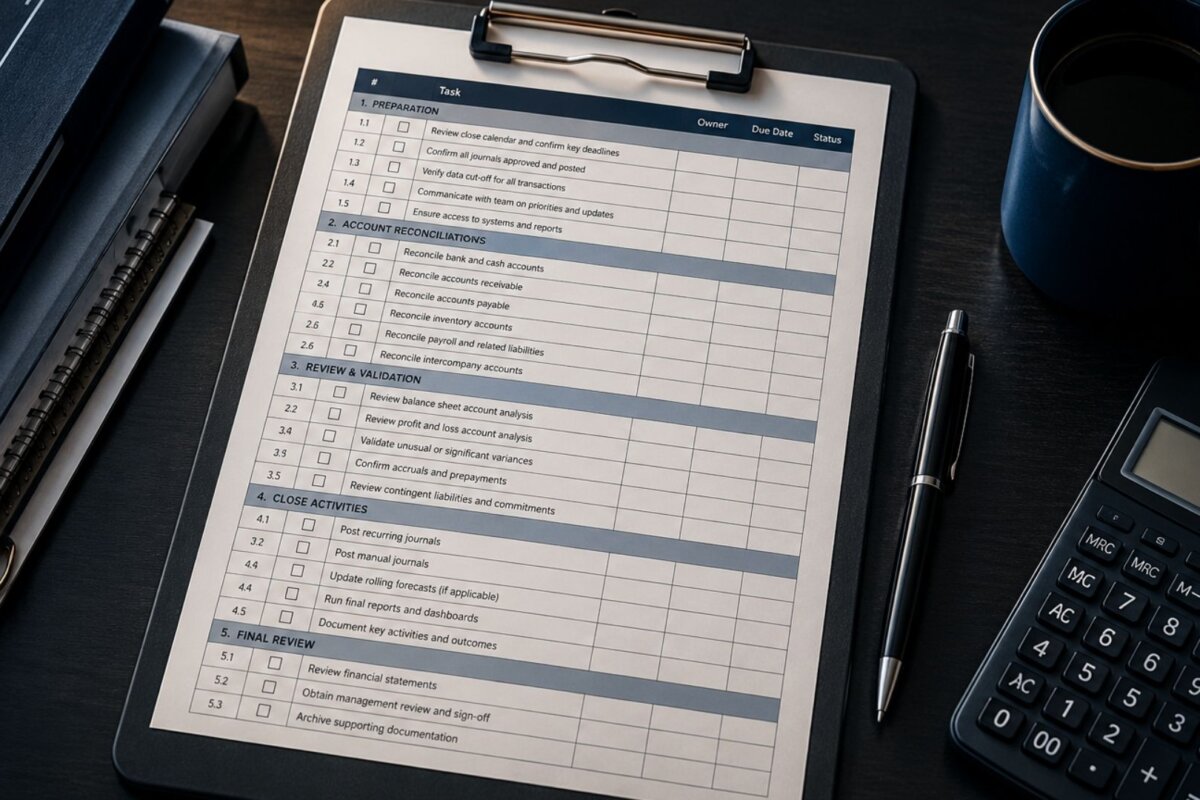
A month end close checklist is the ordered list of tasks required to finalise a period's books, moving from cash and bank reconciliation through accruals and adjustments to final review and sign-off. Most US small businesses can complete it within ten business days.
Why Close Speed Matters More Than Most Founders Think
A slow close is not just an accounting inconvenience. It is a decision delay.
If books close on the 25th, the founder is making February decisions using December numbers. By the time the picture is clear, the month it describes is already gone. Speed is what turns reporting from a record into a tool.
There is a second reason. A month end close checklist that consistently runs long usually indicates the underlying bookkeeping is being done in arrears rather than continuously, which is where errors accumulate. The close is a symptom, not the disease. Continuous daily bookkeeping is what makes a fast close possible.
The Month End Close Process, Phase by Phase
A month end close checklist breaks into three phases, and they are strictly sequential. Attempting phase two before phase one is complete is the single most common reason a close drifts.
Phase one is reconciliation. Every bank account, credit card and payment platform gets matched to the ledger. Nothing else can begin until cash is confirmed, because every downstream figure depends on it.
Phase two is adjustment. Accruals, prepaid expenses, deferred revenue, depreciation and payroll accruals get posted. This is where judgement enters the month end close process, and where a documented policy saves argument.
Phase three is review. Variance against prior period and budget, unusual balances investigated, then sign-off. Skipping this phase is how errors reach the board pack.
Monthly Closing Procedures in Accounting: The Full Task List
Monthly closing procedures in accounting vary by business, but the core task list is remarkably consistent across US small businesses.
Days one to three: cut-off enforcement, bank and credit card reconciliation, cash confirmation, and clearing any uncategorised transactions.
Days four to six: accruals for expenses incurred but not invoiced, prepaid amortisation, deferred revenue recognition, and intercompany entries where multiple entities exist.
Days seven to eight: payroll reconciliation, fixed asset additions and depreciation, inventory adjustments where relevant, and accounts receivable and payable aging review.
Days nine to ten: variance analysis, management review, sign-off, and distribution of the monthly reporting pack. Monthly closing procedures in accounting should end with a distributed report, not a completed spreadsheet.


How to Close Books Faster Each Month
Knowing how to close books faster each month starts with identifying which stage of the month end close checklist is actually consuming the time. Most teams assume it is the adjustments. It rarely is.
Bank feed lag is the usual culprit. If transactions take four days to appear, phase one cannot start until day five regardless of how efficient the team is. Direct bank connections rather than manual imports remove this immediately.
Unreconciled receivables are the second. If AR is only reviewed at close, every disputed invoice becomes a month end problem. Reviewing weekly moves that work outside the close window entirely.
The third answer to how to close books faster each month is unglamorous: write the checklist down, assign an owner to each line, and record the date each is completed. Teams that measure their close get faster. Teams that do not, do not.
Building a Month End Close Checklist Template
A month end close checklist template only works if it names an owner and a target day for every task. A list of tasks without owners becomes a list of things everyone assumes someone else is doing.
The structure below is the one we use across US client engagements. Adapt the task list to the business, but keep the phase structure and the day targets.
| Phase | Target days | Key tasks | Blocked by |
|---|---|---|---|
| 1. Reconcile | Days 1-3 | Bank, credit card and platform reconciliation, cut-off enforcement | Bank feed lag, missing receipts |
| 2. Adjust | Days 4-6 | Accruals, prepaids, deferred revenue, depreciation | Phase 1 incomplete, missing vendor invoices |
| 3. Payroll and assets | Days 7-8 | Payroll reconciliation, fixed assets, AR and AP aging | Payroll provider timing |
| 4. Review | Days 9-10 | Variance analysis, management review, sign-off | Reviewer availability |
| 5. Distribute | Day 10 | Reporting pack issued to leadership | Nothing, if phases 1-4 held |
The Blocked by column is the useful one. It tells you where to intervene when a close starts slipping, rather than pushing the whole team to work faster on the wrong stage.
Fast Close vs Slow Close
Ten-day close | Twenty-day close | |
|---|---|---|
Bookkeeping cadence | Continuous through the month | Batched at period end |
Bank reconciliation | Direct feeds, reconciled weekly | Manual import at close |
Task ownership | Named owner per line | Shared, informally assigned |
Decision usefulness | Acts on current month | Acts on month before last |
The verdict: the difference between a ten-day and a twenty-day close is almost never effort. It is whether the work happens continuously or all at once, and whether anyone owns each line.
EXPERT INSIGHT
Animesh Shah, Accounting Lead at Finkeepers
“We ask every new client one question: on what date did you close last month? If they cannot answer, that is the first thing we fix. You cannot improve a close you are not measuring. Most teams pull two or three days off the timeline in the first quarter simply by writing the checklist down and recording completion dates.”
A month end close checklist is as much a management tool as an accounting one. It makes the bottleneck visible, and visible bottlenecks get fixed.
PUT THIS INTO PRACTICE
If your close currently runs past the fifteenth, the fix is usually structural rather than a matter of working harder. A review of where the time actually goes takes an hour and typically finds two or three days.

FREQUENTLY ASKED QUESTIONS
Everything US Businesses Ask,About the Month End Close
What is included in a month end close checklist?
A month end close checklist covers bank and credit card reconciliation, cut-off enforcement, accruals and prepaid amortisation, deferred revenue, payroll reconciliation, fixed asset depreciation, AR and AP aging review, variance analysis and final sign-off, followed by distribution of the reporting pack.
How long should the month end close take?
Ten business days is the working benchmark for US small businesses. Larger or multi-entity companies may take twelve to fifteen. Anything beyond twenty days usually indicates bookkeeping is being done in arrears rather than continuously through the month.
What order should month end close tasks be done in?
Reconciliation first, then adjustments, then review. The sequence is strict because every adjustment depends on confirmed cash balances, and review depends on completed adjustments. Attempting them in parallel is the most common cause of rework.
How can a small business close its books faster?
Connect direct bank feeds rather than importing manually, reconcile receivables weekly rather than at close, assign a named owner to every checklist line, and record the completion date each month. Most teams find two to three days in the first quarter.
Who should sign off on the month end close?
Whoever is accountable for the numbers externally, typically the founder, finance lead or fractional CFO. Sign-off should follow variance review, not precede it, and should be recorded with a date so the close timeline is measurable month to month.
What is the difference between a soft close and a hard close?
A soft close skips some adjustments to produce faster indicative numbers, usually mid-quarter. A hard close completes every procedure and produces figures suitable for external reporting. Most US small businesses run hard closes monthly and do not need a soft close at all.
A month end close checklist is the cheapest process improvement available to most US small businesses. Writing it down costs an afternoon and typically removes days from the timeline within a quarter. Finkeepers runs the close for US startups and SMBs as part of ongoing bookkeeping and financial reporting, with the pack delivered by the tenth business day. It also feeds directly into reliable cash flow forecasting. Talk to a Finkeepers accountant if your close keeps slipping.
See what US businesses say about working with Finkeepers on Clutch.

Written by the Finkeepers Team
Getting the 1099 threshold 2026 right comes down to one thing: knowing what you paid each vendor before January arrives. If contractor payments are spread across cards, bank transfers and platforms, that visibility is worth building now. Finkeepers handles contractor and 1099 management for US businesses as part of ongoing payroll support — talk to a Finkeepers accountant if January filing is already looking complicated.
Disclaimer: This article is provided for general informational purposes only and does not constitute tax, legal or accounting advice. Close procedures and reporting requirements vary by business type, entity structure and jurisdiction. Consult a qualified professional before changing your accounting processes. Finkeepers accepts no liability for decisions made on the basis of this content. Current as of August 2026.

Get Your Free Financial Reporting Consultation Today
*No obligations. Just fast, expert financial reporting insights tailored for your US business needs.

Built by experienced professionals, Finkeepers delivers reliable accounting services for startups and SMBs, powered by proven processes and modern software.
Contact Info:
-
Address: 30 N Gould ST STE R, Sheridan, Wyoming, 82801 United States
-
Email: hi@finkeepers.us
-
Phone: +1-408-370-2711