
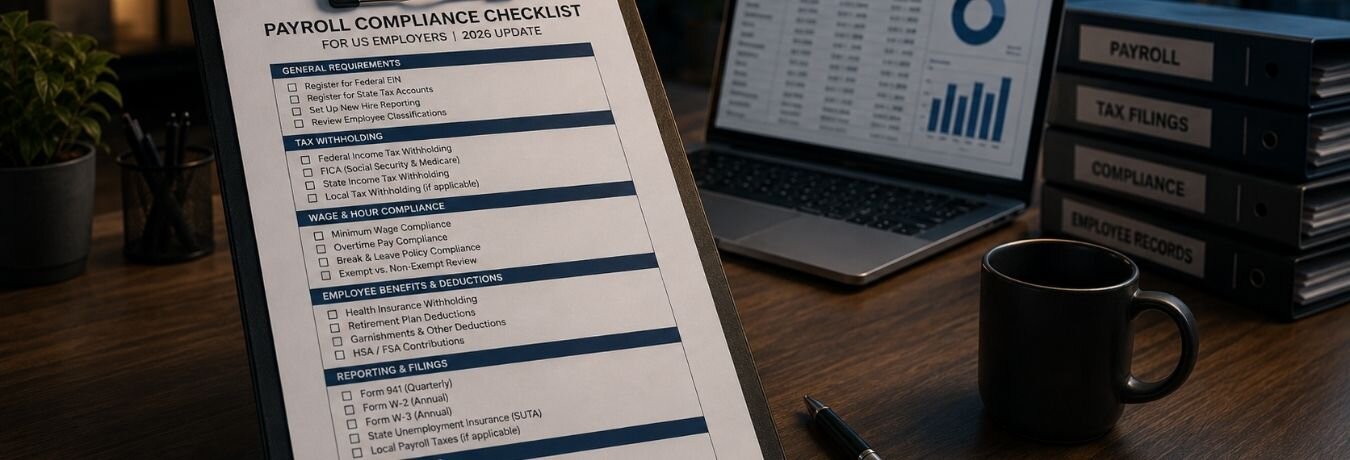
Payroll compliance is not difficult. It is just wide, and the wide parts are where US employers get caught.
Most US employers handle federal payroll obligations reasonably well. The gaps appear at state level, in local ordinances, and in worker classification, where the rules differ by jurisdiction and change more often than anyone tracks. A written checklist is what stops that becoming a discovery at year end.
The 2026 wage base moved. Most other deadlines did not.
"Nobody fails payroll compliance on the 941. They fail it on a state registration nobody knew was required, six months after the hire who triggered it."
PANKAJ GOHEL
Key Takeaways
Here is the federal, state and local surface employers are responsible for, the 2026 figures that changed, and the deadline calendar. Most of the risk sits outside the federal forms.
- The 2026 Social Security wage base rises to $184,500
- Federal forms 941, 940, W-2 and W-3 keep their existing deadlines
- Electronic filing mandates expanded again for 2026
- State obligations do not automatically follow federal ones
A payroll compliance checklist covers the federal, state and local obligations a US employer carries each period: withholding and deposits, quarterly and annual filings, worker classification, and record retention. The federal layer is the smallest part of it.

The Compliance Surface Most Employers Underestimate
Payroll compliance is usually described as a federal responsibility. In practice the federal layer is the narrowest of the three and by some margin the best documented, which is exactly why it causes the fewest problems.
Underneath the federal layer any payroll compliance checklist has to carry fifty state withholding regimes, fifty unemployment insurance systems, a growing number of state paid leave programmes, and local ordinances that apply at city level in several major metros. Each has its own registration, its own deadlines and its own forms.
Any small business payroll compliance guide earns its place by making that surface visible. Employers rarely miss what they can see on a list. They miss what nobody wrote down.
Federal Payroll Compliance Requirements
The federal payroll compliance requirements are consistent across every US employer regardless of state.
Form 941 reports federal income tax withheld plus Social Security and Medicare, filed quarterly. Form 940 covers federal unemployment tax and is filed annually. Forms W-2 and W-3 report annual wages and are due to both employees and the Social Security Administration by 31 January.
Deposits sit separately from filings on the payroll compliance checklist and run on their own schedule, either monthly or semi-weekly depending on prior-period liability. Missing a deposit deadline is a distinct failure from missing a filing deadline, and employers frequently conflate the two.
Federal payroll compliance requirements also cover Form 1099-NEC for contractors, which moved to a $2,000 reporting threshold for 2026. Our guide to the 1099 threshold change covers that in full.
The 2026 Figures That Changed
Two figures on the payroll compliance checklist moved for 2026, and both affect calculations rather than deadlines.
The Social Security wage base rises to $184,500. Earnings above that figure are no longer subject to the Social Security portion of FICA, though Medicare continues without a cap. Payroll systems generally update this automatically, but anyone running calculations manually needs to change it.
Electronic filing mandates expanded again. Digital submission is now the default expectation for nearly every US business, and the thresholds at which paper filing remains permitted continue to tighten. Employers still filing on paper should assume that option narrows further.


Employer Payroll Obligations at State and Local Level
Employer payroll obligations at state level begin with registration, and registration is triggered by where the employee works rather than where the business is incorporated.
Each state operates its own income tax withholding regime, its own unemployment insurance system with its own rate schedule, and in a growing number of cases its own paid family and medical leave programme funded by payroll deduction.
Local obligations add another layer in several major metros. City income taxes, local payroll expense taxes and municipal paid sick leave ordinances all exist and all sit outside state filings.
Employer payroll obligations also include record retention. Payroll records, timesheets and tax filings must be retained for defined periods that differ between federal and state requirements, and the longer period governs. This is one of the reasons outsourced payroll tends to reduce risk rather than just workload.
The Payroll Compliance Checklist 2026
The payroll compliance checklist 2026 below covers the recurring obligations most US employers carry. State-specific items sit on top of it and vary by jurisdiction.
Assign an owner to each line. A payroll compliance checklist without owners is a list of assumptions.
| Obligation | Frequency | Deadline | Level |
|---|---|---|---|
| Federal tax deposits | Monthly or semi-weekly | Per deposit schedule | Federal |
| Form 941 | Quarterly | End of month following quarter | Federal |
| Form 940 (FUTA) | Annual | 31 January | Federal |
| Forms W-2 and W-3 | Annual | 31 January | Federal |
| Form 1099-NEC | Annual | 31 January | Federal |
| State withholding return | Varies by state | Varies by state | State |
| State unemployment insurance | Usually quarterly | Varies by state | State |
| Paid leave contributions | Varies | Where programme exists | State / local |
The Level column is where attention belongs. Federal rows are identical for every US employer. State and local rows change with every jurisdiction an employee works in, and those are the rows that go wrong.
Employee vs Contractor Classification
Employee (W-2) | Contractor (1099) | |
|---|---|---|
Tax withholding | Employer withholds and deposits | Worker responsible |
Employer taxes | FICA match, FUTA, SUTA | None |
Annual form | W-2, due 31 January | 1099-NEC above $2,000 |
Misclassification risk | Low | High, and states apply their own tests |
The verdict: classification is the highest-exposure line on any payroll compliance checklist for US employers. Several states apply tests stricter than the federal standard, so a worker correctly classified federally can still be misclassified at state level.
EXPERT INSIGHT
Animesh Shah, Accounting Lead at Finkeepers
“The federal filings are the easy part. Every payroll system handles them. What we spend time on is state registration for new hires, because a single remote employee in a new state creates obligations from the first pay run, not from the first filing deadline.”
A payroll compliance checklist is most valuable at the point of hire, not the point of filing. By filing season the obligations already exist.
PUT THIS INTO PRACTICE
No small business payroll compliance guide replaces a jurisdiction-by-jurisdiction check. If your team has grown across state lines in the last year, the registrations are worth auditing before the next quarterly cycle. Catching a gap in month three is inexpensive. Catching it at year end is not.

FREQUENTLY ASKED QUESTIONS
Everything US Employers Ask,About Payroll Compliance
What is included in payroll compliance for US employers?
A payroll compliance checklist covers federal withholding and deposits, quarterly Form 941, annual Form 940, W-2 and W-3 filings, contractor 1099s, state withholding and unemployment insurance, paid leave contributions where programmes exist, worker classification and record retention. The state layer is usually larger than the federal one.
What is the Social Security wage base for 2026?
The 2026 Social Security wage base is $184,500. Earnings above that figure are not subject to the Social Security portion of FICA, though Medicare continues with no cap. Payroll software usually updates this automatically.
What payroll forms does a small business need to file?
Form 941 quarterly, Form 940 annually, and W-2 with W-3 by 31 January. Contractors receiving $2,000 or more need a 1099-NEC, also due 31 January. State withholding and unemployment returns sit on top of these and vary by jurisdiction.
Do I need to register for payroll tax in a new state?
Generally yes, and the trigger is where the employee works rather than where the business is incorporated. A single remote hire in a new state usually creates registration and withholding obligations there from the first pay run.
What are the penalties for late payroll tax filing?
Penalties apply per filing and increase the longer a return or deposit is late, with higher amounts where the failure is treated as intentional. Deposit and filing failures are assessed separately, so missing both on the same period compounds the exposure.
How long should payroll records be retained?
Federal and state requirements differ, and the longer applicable period governs. Payroll registers, timesheets, tax filings and employee records should be retained on a documented schedule rather than a best guess. Verify each state you employ in separately.
A payroll compliance checklist is worth writing down precisely because the obligations are wide rather than complicated. Most failures we see are registrations nobody knew were triggered, not calculations anyone got wrong. Finkeepers handles outsourced payroll for US employers including multi-state registration and filing, alongside bookkeeping and financial reporting. Talk to a Finkeepers payroll specialist before the next quarterly cycle.
See what US businesses say about working with Finkeepers on Clutch.

Written by the Finkeepers Team
Getting the 1099 threshold 2026 right comes down to one thing: knowing what you paid each vendor before January arrives. If contractor payments are spread across cards, bank transfers and platforms, that visibility is worth building now. Finkeepers handles contractor and 1099 management for US businesses as part of ongoing payroll support — talk to a Finkeepers accountant if January filing is already looking complicated.
Disclaimer: This article is provided for general informational purposes only and does not constitute tax, legal or accounting advice. Payroll requirements, thresholds and deadlines change and vary significantly by state and locality. Verify all figures against IRS.gov, SSA.gov and the relevant state agency, and consult a qualified professional before filing. Finkeepers accepts no liability for decisions made on the basis of this content. Current as of August 2026.
Get Your Free Payroll Consultation Today
*No obligations. Just fast, expert payroll insights tailored for your US business needs.

Built by experienced professionals, Finkeepers delivers reliable accounting services for startups and SMBs, powered by proven processes and modern software.
Contact Info:
-
Address: 30 N Gould ST STE R, Sheridan, Wyoming, 82801 United States
-
Email: hi@finkeepers.us
-
Phone: +1-408-370-2711